
A Blueprint for Cleaner Air: BMC's Journey Towards Standardized Air Quality Monitoring at Construction Sites
Published: June 19, 2025 | By Team Sathicorp AQMS
Introduction: A New Rulebook for Construction Sites
Air pollution from construction activity is now under the scanner. In 2025, new mandates by BMC, MPCB, and the Bombay High Court made it compulsory for construction sites to install AQMS (Air Quality Monitoring Systems).
But what does AQMS actually involve? Is it just a sensor? A display? An app? This blog is your complete breakdown of what every builder, project manager, or civil consultant needs to know.

The Regulatory Landscape: BMC's Comprehensive Journey
The journey towards stringent air quality control began with BMC's proactive stance on air pollution in the Mumbai Metropolitan Region (MMR). This comprehensive approach ensures healthier environments for all.
Phase 1: The Initial Mandate – Laying the Foundation for Change
The foundation was set by the Hon. Municipal Commissioner's "Guidelines for Air Pollution Mitigation" (MGC-F-1102 DTD.25.10.2023) issued by the Hon. Municipal Commissioner, clearly mandated that all construction sites to deploy sensor-based air pollution monitors at work sites and act immediately on observing pollution levels exceeding the limit. This was further reinforced by the Hon. High Court of Bombay's order in SMPIL/03/2023, dated 09.01.2025 , which explicitly directed the installation of such devices at all construction sites in which construction is in progress, with readings to be displayed.
Learn more about the initial guidelines: BMC Air Pollution Mitigation Guidelines (MGC-F-1102 DTD.25.10.2023)
Phase 2: Standardization through a Rigorous EOI Process
Recognizing the necessity for standardized and reliable monitoring, BMC initiated an Expression of Interest (EOI) process for "Shortlisting of technology and make & model for sensor-based air pollutants measuring units/devices (PM 2.5 & PM 10)". The core purpose of this EOI was to meticulously select and shortlist specific technologies, makes, and models for these units, aiming to provide end-users – builders, developers, and contractors – with a clear, uniform standard for standardized air pollution sensor units/devices approved by BMC. The EOI invitation opened on 17.02.2025, with a submission deadline of 03.03.2025.
Throughout this rigorous process, BMC demonstrated commendable transparency and adaptability. They managed the process through various updates and clarifications, including **Corrigendum – III** (Ch. Eng./ Env. & C.C./432 dtd. 13.03.2025) , which, for instance, expanded acceptable sensor certifications to include AirParif and performance evaluations by IITs and CSTEP. Comprehensive replies to bidder queries, like those in the **'Complied Queries' document**, further addressed industry questions, ensuring clarity on BMC construction guidelines air pollution and operational expectations.
The Milestone: Shortlisting of Approved Models
After a thorough evaluation, BMC recently announced the shortlisting of 13 sensor makes and models as listed in Annexure B. These models comply with the stringent technical specifications in Annexure A. All construction projects with an estimated cost below ₹500 Crores are now specifically required to install these BMC air quality sensors Mumbai construction approved devices and display real-time AQI data through an air quality LED display board at the construction site. Furthermore, this air quality data must be accessible at the site for inspection by BMC officials and integrated with BMC's Command & Control center via APIs.
The Journey Continues: Ensuring Long-Term Accuracy
It's crucial to understand that the process doesn't end with shortlisting. The BMC's commitment to clean air extends to ensuring continuous accuracy and reliability. As stated in the circular, If any listed sensor models is found non-compliant during the co-location study, it will be removed from the list. This critical phase ensures that only truly reliable and accurate devices are deployed for construction pollution monitoring Mumbai.
The current list of shortlisted makes and models is valid for the next three years, until May 30, 2028, with provisions for future updates. The guidelines also mandate periodic calibration every two months , internal memory for 60 days of local data storage to prevent loss during network issues , and a strict maintenance protocol including 6-hour fault address and 24-hour replacement timelines.
BMC's comprehensive approach, from mandating deployment to a detailed selection and ongoing verification process, sets a robust standard for air pollution mitigation in the MMR. This ensures that all construction sites to deploy sensor-based air pollution monitors at work sites and act immediately on observing pollution levels with confidence in their data's accuracy and reliability.
1. What is AQMS? A Simple Breakdown
AQMS stands for Air Quality Monitoring System, and it’s made up of:
- Environmental sensors: Measure PM2.5, PM10, noise, temperature, humidity
- Digital display (Approx. 3x4 ft LED): Shows real-time AQI to the public
- Cloud dashboard: Stores data, enables inspection reporting
- Connectivity: Sends data to online platforms for visibility and alerts
2. Who Needs AQMS and Where?
All under-construction sites within municipal limits of Mumbai, Pune, and other high-density areas in Maharashtra are under AQMS enforcement — especially those:
- Larger than 500 sq. m.
- With deep excavation or multiple machinery
- In proximity to schools, hospitals, or residential areas
This applies to:
- Builders & developers
- Civil contractors
- Infrastructure project managers
- Consultants submitting site compliance forms
3. Key Features to Look For
| Feature | Why It’s Important |
|---|---|
| Certified PM2.5 & PM10 sensor | Measures construction dust accurately |
| LED Display (Approx. 3x4 ft) | Complies with visibility norms |
| Real-time AQI Calculation | Helps act fast on high-pollution readings |
| Cloud Dashboard | Stores historical data for audits |
| Local Support | For on-site issues and maintenance |
4. AQMS is Not Just for Show – It’s a Legal Requirement
Following the Suo Moto PIL 3/2023, courts have mandated real-time air pollution visibility for public health. This isn’t a best practice — it’s law.
Regulatory trends show that compliance checks are increasing. Sites without AQMS may face:
- Show-cause notices
- Project delays
- Future approval complications
5. Prepare Now: Compliance is Coming in Waves
- Mumbai (BMC) is actively inspecting sites
- Pune (PMC) is following with awareness campaigns
- Other cities in Maharashtra are expected to follow BMC’s model
- Enforcement teams are using GPS location + public complaints to check AQMS
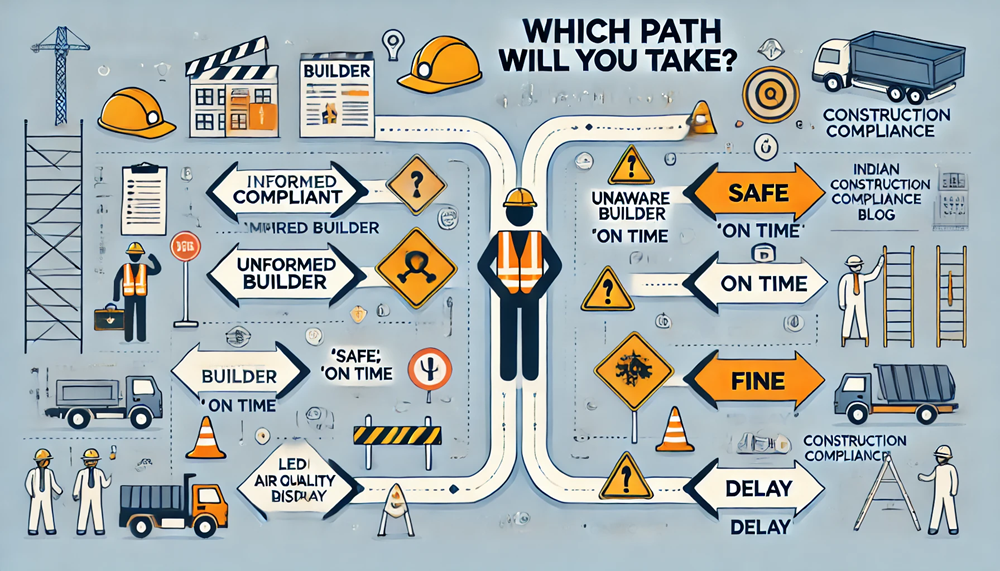
Final Thought: Be the Informed Builder, Not the Penalized One
Builders who stay updated and take early action will avoid fines, build trust, and lead by example in sustainability. The time to act is before the approved list comes out — not after.
Ready to ensure your construction site's compliance with state-of-the-art AQMS displays?
Download our FREE Compliance Checklist to make an informed decision.
Visit Our Solutions Page